Welcome!


Welcome!! This blog features cannabis and neurological research, wellness journals and more. Please subscribe by email to keep up with my posts. Thank you for visiting! ~CC
Showing posts with label neurological disorder. Show all posts

Tuesday, October 14, 2014

Research | Functional Neurological Disorder Diagnosis Acceptance

Dear, Readers! First off, I would like to apologize that I haven't been writing blog posts for my "31 Days to Free Your Mind about Cannabis" series. I've been having some hard health days lately and I'm just not able to keep up. The stress of trying isn't helping either. I am committed to completing the project, but it will take me quite a bit of time to catch up and I'm going to do it slowly so it can be done correctly. :)


I have been diagnosed with Psychogenic Movement Disorder by three different neurologists, and, until today, I did not believe it. There isn't much research on this disorder in the U.S., but the world's leading expert, Dr. Mark Edwards, is in the UK and that's where all research on it stems from. In the UK, Psychogenic Movement Disorder is classified as Functional Neurological Disorder or Conversion Disorder. I prefer the term, Functional Neurological Disorder, over Psychogenic, because after just a bit of research, I discovered that it is actually a physical disorder, not a psychological one. While watching the following videos I started to believe that Functional Neurological Disorder is my correct diagnosis. Take a look and see why.


Holly's Conversion Disorder Fight, 5 min.
This video shows that the symptoms are very real. Health experts cannot explain FND fully.


Second Opinion | Conversion Disorder, 26 min.
Listen to the neurologist's explanation of how this is diagnosed and
"...the differences between neurology and psychology are becoming increasingly blurred."

After watching this video I looked up the definition to further my education.

What is Functional Neurological Disorder?

It is important to note here that the terms, "Functional Neurological Disorder" and "Conversion Disorder" are used primarily in the UK where the world's leading expert resides. This leaves many confused on their diagnosis and struggling to find where they fit in.  They individually mean different things, however, they are all labels for the same disorder.
Functional Neurological Disorder provides an umbrella term for a variety of symptoms of apparent neurological origin but which current models struggle to explain psychologically or organically.  Presentation may be similar to a wide range of other neurological conditions.  FND/CD can be as debilitating as Parkinson’s disease and MS and have many similar symptoms.  The most common misconception is that patients are in control of some or all of their symptoms.  The patient does not consciously produce functional symptoms.   A patient with conscious control of their symptoms has a different diagnosis such as Feigning, Malingering, or Munchausen Syndrome.

Functional Neurological Disorder can present with any motor or sensory symptoms in the body including:
Given the occurrence of these medically unexplained symptoms in patients with organic brain injury, spinal injury, post-anesthesia and post-viral illnesses, the modern term moves away from psychodynamic theory and provides a useful label for what is a complex and little understood disorder. [Source]

 What is Psychogenic Movement Disorder?

To better explain this disorder, I find it pertinent to add this information from the U.S.
Psychogenic movement is an unwanted muscle movement such as a spasm or tremor that is caused by an underlying psychological condition. Psychogenic movement can involve any part of the body and resemble the same muscle movements that occur with a biological condition or structural abnormality. Most psychogenic movement is involuntary—done without being consciously initiated by the individual. Psychogenic movement may develop as part of a conversion disorder (in which a psychological event causes physical symptoms with no known medical cause). It also may result from a somatoform disorder (characterized predominantly by multi-system symptoms that are associated with distress and/or dysfunction), factitious disorder (an illness that simulates symptoms for psychological reasons), or malingering (not characterized as a psychiatric disorder but where illness is pretended as a way to achieve a secondary goal such as the acquisition of drugs or disability benefits). Unlike movement disorders caused by biological or structural conditions, psychogenic movement disorders commonly develop suddenly, progress rapidly to maximum severity, may increase in intensity, and come and go with complete or partial remissions.  The movement may be less when the person is distracted, and the severity of symptoms varies among individuals.  The course of the psychological condition may be short-lived or lead to chronic disability.  
Psychogenic movement is uncommon before the age of 10 years. In children, the dominant limb is most often affected, while adults most frequently see movement in the nondominant limb. 
Psychogenic movement disorders include: 
Psychogenic tremor (also called functional tremor) can appear as any form of tremor movement. Characteristics may vary but generally include sudden onset and remission, increased incidence with stress, change in tremor direction and/or body part affected, and greatly decreased or disappearing tremor activity when the person is being distracted. Many individuals with psychogenic tremor have a conversion disorder. 
Psychogenic dystonia involves involuntary muscle contractions that cause slow, repetitive movements or abnormal postures that are often severely painful. Onset may be abrupt or appear as part of a recurring attack. Psychogenic dystonia typically involves fixed postures, particularly from the start, whereas dystonia caused by a muscle or structural abnormality tends to involve more mobility and be action induced.Psychogenic myoclonus refers to sudden, involuntary muscle contractions (twitches) or jerking of a muscle or group of muscles that are caused by a psychological condition. Myoclonic jerks may occur alone or in sequence, in a pattern or without pattern. Increased startle or startle-like movements are frequent. Psychogenic myoclonus may occur spontaneously or be generated by an action or reflex. The twitching cannot be controlled by the person experiencing it. 
Psychogenic parkinsonism involves rigid movements that are extremely slow and often associated with a great sense of effort and rapid onset of severe fatigue. Individuals with psychogenic parkinsonism may also have tremor. Symptoms are usually seen on both sides of the body. 
Psychogenic gait disturbances feature unusual patterns of stance and gait. Individuals may stagger or veer from side to side when walking and appear to be losing their balance, but only rarely fall. Sudden knee buckling without falling is common. [Source]
The Research Process...

My brain was going overtime after watching the videos and reading the symptom list and definitions. The first video was shocking. The young lady had shaky voice issues just like me and, though her symptoms were more extreme than mine, I noticed that the twisting motions were the same. Her diagnosis was the same as mine. The second video explained more to me how a doctor actually comes to a diagnosis and I began to think about why it was that doctors were having such a hard time finding out what was wrong. Why weren't the tests conclusive? Why weren't medical tests like EEGs and MRIs showing problems when patients were obviously not faking it? According to the statistics, psychogenic movement disorder is the most common movement disorder in the spectrum of movement disorders with 2-3% of the world's population diagnosed as psychogenic. That means that movement disorder specialists see this type of movement more than any other movement disorder. That means that they must know by now what to look for. It was interesting to hear in the second video what differentiates the tremor in psychogenic movement disorder from a Parkinson's tremor. After watching the video, I knew that I believed I the legitimacy of my medical diagnosis.


I looked online and found that the facts presented in the videos were mirrored by other stories and accounts. I found a Functional Neurological Disorder/Conversion Disorder/fndhope.org group on FB and over 1,000 people discussing their diagnosis. Some of them didn't believe the diagnosis and some of them did. They all experience similar mysterious symptoms, but not all of their disorders present the same. Some of them have just one psychogenic component of the disorder like psychogenic epilepsy while some have multiple areas of concern. Some are attempting to heal themselves with EDMR, a PTSD psychological technique, to access the initial trauma that started their illness. Others focus on their physical symptoms and see occupational therapists to help them relearn how to use their bodies. Some say that their symptoms started in childhood and that they have family members that have Functional Neurological Disorder as well. This last part is particularly interesting both for the fact that this can't be a just a mental illness and for the fact that it can be genetic. That this happens in families also sets my mind at ease about this diagnosis since my recently estranged sister has the same disorder.

I noticed during my research on different types of neurological disorders that almost every condition has a mental illness component. Parkinson's, Huntington's, Lyme disease, fibromyalgia and epilepsy all list depression or anxiety as a symptom. I find it safe to say that there is much more medical research that needs to be done on this disorder. When functional neurological disorder patients hear that this disorder is caused by psychiatric trauma, they automatically discount it because they know that they are not making up their symptoms. Some patients have never even experienced any trauma and, therefore, don't believe their diagnosis.

Neurology and psychology are blurred in FND...

One thing that is abundantly clear is that all functional neurological disorder patients are all suffering and they are all upset with the way the medical community has classified the disorder as a mental illness. There is research coming out of the UK from the University of Cambridge that says that when an organic dystonia is present that the brain does something abnormal in one direction. The psychogenic brain is abnormal, too, but in the opposite direction of the organic disorder. This proves that Functional Neurological Disorder is indeed a neurological disorder, instead of a mental illness.


I had heard that I was crazy from doctors before. The first time I heard that my symptoms were in my head was in 2002 after my auto accident with an 18 wheeler. The back doctor told me that he didn't understand why I was in so much pain. I had numerous shots in my back, but still needed vidodin for the pain. After completing a dye test that showed that I had bad disks, I stopped seeing doctors except once a year for pain meds. Then, again, years later when I saw a gastro doctor for a vomiting problem that lasted over a year (it later resolved itself for no apparent reason) they told me that they didn't know what was wrong with me. So, I was fed up with doctors telling me that my symptoms were in my head. I thought I was just seeing stupid doctors, so I changed doctors every time.


I completely understand why anyone that receives this diagnosis wants to refute their doctor's findings. Most doctors are scientist type personalities and are missing a sensitivity chip. If patients were told from neurologists, "All neurological disorders have a component of mental illness and this one is not any different. You have a mysterious neurological illness that may or may not be caused by previous trauma. I can help you with medications, but PTSD therapies and occupational therapy have shown great results in your disorder," then that would make more of an impact.


All neurologists across the world agree that the quicker you can get this diagnosed and the quicker you get into treatment the more likely that Functional Neurological Disorder can be cured, but that happens infrequently. Most patients have reoccurring psychogenic illnesses for the rest of their lives. The disorder cannot be cured and most patients are using prescription medications and psychological therapies to control their symptoms.


Everything happens for a reason...


One more thing to note... After receiving my first diagnosis over a year ago, I researched this topic and found Dr. Jankovic, but forgot about him. A year later, as I was about to give up, I remembered only that he was a leading movement disorder specialist. I saw him two weeks ago and his diagnosis was psychogenic movement disorder. He, too, is missing a sensitivity chip, but not as much as some of the other neurologists. I left his office disappointed and ready to give up on all western medicine doctors. If I hadn't seen Holly's video and heard her story, then I may have gone the rest of my life disbelieving my correct diagnosis. 


Everything happens for a reason. A year ago I wasn't meant to understand, but after watching Holly's video I have hope. Thank you, Holly, for being brave enough to share your story. I will be forever grateful. :)


Holly's Conversion Disorder Follow-up Video, 6 min.

Tuesday, September 9, 2014

Progress | Dysfunction Junction Part 3


 Continued from Dysfunction Junction Part 1 and Part 2

Another scary night. Bill and I had just finished making love when I had a seizure. I think these are seizures after talking with my sister and with my nurse friend.

I arched my back, pushed my neck into the mattress and lifted my hips. I felt the tremor start at the base of my spine and travel up to my neck. I gasped from anxiety then struggled to breathe. I felt my temples swell and bright lights pulse while my eyes were closed. It was hard to hear Bill ask if I was alright. I tried to answer, but I couldn't get any words out. My body convulsed and it drew into itself in the fetal position. It was scary to say the least.

 I gasped for air and started to get panicked. Something told me to calm down, so I let go of my control. I finally was able to tell him, "No," and my body relaxed.

I cried for a bit afterwards. This is so scary. I'm losing control of both my brain and my body at the same time. 


Saturday, August 16, 2014

Treatment Plan | The Secret: Belief + Intent + Action = A Healthy Me!


I went for my very last doctor appointment this week and it made me decide not to see another western medical doctor again. I've made this decision because I need to focus my energies elsewhere. My mental health needs them the most and I don't have time to have negative energy make waste of the progress I've made when it comes to how zen I've been feeling lately.

I've been doing a lot of research and I keep finding myself equating neurological disorders and mental illness. They seem so intertwined with one another. They are all deeply affected by chemicals and react so similarly with medical marijuana. I've been exploring organic food and marijuana as treatment plans for my neurological disorder, but I believe there's something more...something that all of us should have as a wellness treatment.

One realm I keep coming back to in my research is to think positive. In fact, I believe that there are the parts of the brain that have yet to be explored and there is much to understand between how our food and medicine affects the brain and how positive energy affects it as well. Positive thinking, aka the placebo effect, is pretty intriguing. Is it really mind over matter? And what does that have to do with the law of attraction and my wellness plan?

I believe that there's an area of the brain that is unexplored that when activated regenerates cells in the human body. 


There is much scientific evidence that says that placebos are real. If people think that a medicine cures them that it will. Think about what that says about the power of the mind. Think about what this could mean for all neurological patients. If I'm correct, this could be another avenue towards wellness.

The law of attraction says that in order to have something wonderful happen in your life that you have to believe it into existence. If you believe and you know your intent, then it will be so. But it's not enough to have belief and intent. You must also have time to visualize it happening. Visualize it and it will be so. Take five minutes out of the day to remember a time when you felt the most loved. Remember how it felt, what it smelled like, the colors. Now feel that. Use it to combine with the intent that you want. Continue this practice daily. Remember not to dwell and worry about what you want. At the end of your visualization give it up to the universe. Don't think upon it further. The more you think and think about it, the more negativity you put into it. The best thing to do is live in the moment and let go of all control and all responsibility for the outcome.

This philosophy will require some thinking and retraining of the brain. I have to learn to let go of control and let go of my daydreaming. I have to visualize what I want and what I want is wellness. I need to visualize myself as healthy. What would that look like? What would I do if I weren't confined to my home all day? What would I accomplish? And do I want that? What is it that I want? Do I want to be healthy?

If the answer is yes, then I visualize how beautiful, happy and healthy I am. Notice the language. I did not say that I would hope that I was beautiful, happy and healthy. I said that I already was. Assume that it is already the way you envision it.

I believe the secret is a simple equation. Belief + Intent + Action = Healthy Me. At least that's my new treatment philosophy!

Wellness Journal | Cannabis Oil Concentrate Short Study Day 2

I took the first dose last night and feel fine. I felt it almost immediately. My spouse says that's not possible, but it's how I felt. Within an hour I was pretty woozy. This morning I woke to less pain and my hand and wrist look somewhat normal!!!


10:40 AM 
Pain level: 6 out of 10.
Time for my next dose at 11am, then again at 4pm and 10pm.

Didn't take a dose at 11 AM so it took some more at 1 PM. I'm kind of getting used to the taste.


1pm Cannabis Oil Dose

8/24/14 Notes: 
I was so super doped up the rest of the day that I didn't do much! I was woozy and tired. I kept falling asleep whenever I sat still for just a moment. It was kind of surreal how much it made me tired. I was still feeling pain, but nothing like before.

The dreams were impressive. I've never had such lucid dreams before. I also remember waking up in a panic, like a panic attack, thinking that something was wrong. Realizing nothing was wrong, I drifted back into sleep. Sleep was really difficult the first night mostly because my sleeping was so lucid. I knew what was going on around me and during my dreams. It was very odd and I had a difficult time adjusting to the feeling.

DISCLAIMER: These journals are intended for informational purposes only.
Help with the cramping and the tremors but doesn't get rid of them.

Going to get a scale today and some gelatin capsules. 


Thursday, August 14, 2014

Doctor Notes | Eastern Medicine Kind of Girl

To prepare for my appointment with Dr. Georgette Varga, a movement specialist and neurologist in Austin, Texas, I wrote the following note and emailed it to her a couple of days ahead of my appointment.

Current Symptoms

Memory problems
 Weakness in both arms, L worse concentration
 Afraid of falling
 Anxiety
 Dizzy spells: happen when sitting/standing up
 Weight change: lost 20 pounds since November
 Vision changes
 Fatigue
Incontinence
 Pain level consistently between six and eight out of 10
Leg movements when going to sleep: slow movement has been happening since birth
Rocking since birth
Tremors
 Chronic Constipation
 Cramping in left and right arms, both shoulders and neck
Pain in left arm/chest
Feel like difficult to stop, difficult to start. Ex: projects

Things to Note:
Grandfather was a Korean vet who had diabetes, heart attacks, strokes, prostate cancer and Alzheimer's.
Father died of mass tumor in his body that caused surgeons to remove pancreas and part of his stomach. Died of septic shock and stroke.
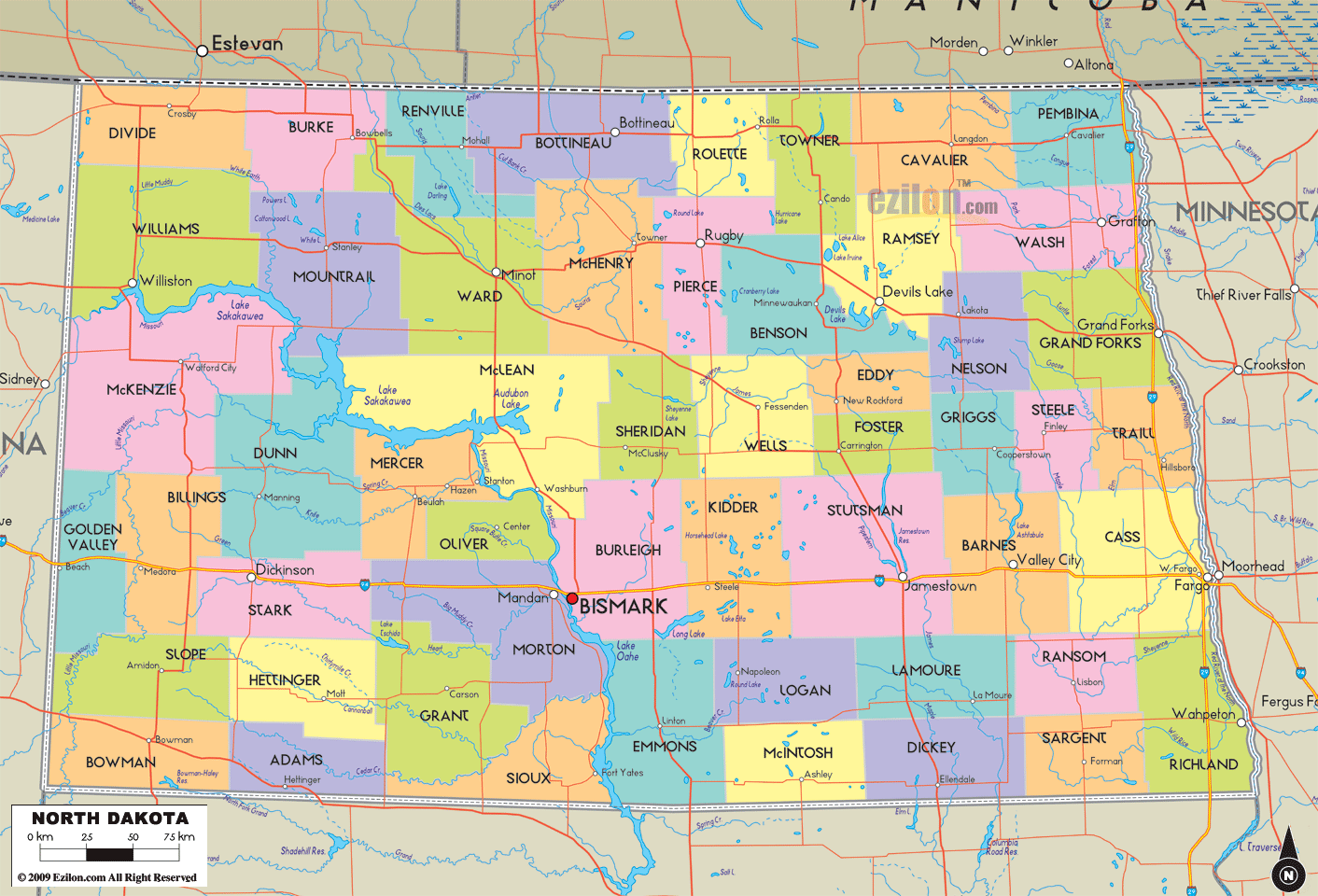
 I was born in North Dakota where the Parkinson's test rate is higher than that of the rest of the country. 2, 4– D was sprayed on the field near the Minot Air Force Base where I was born.
 I've had symptoms since 2009. I've been off antipsychotics since 2011.
I am still progressing.

Research I'm sharing:
North Dakota Parkinson’s Death Rate :http://www.worldlifeexpectancy.com/usa/north-dakota-parkinsons-diseaseNorth Dakota County Map: http://www.ezilon.com/maps/images/usa/north-dakota-county-map.gifNutrients, Suspended Sediment, and Pesticides in Water of of the Red River of the North Basin, Minnesota and North Dakota, 1990-2004: http://pubs.usgs.gov/sir/2007/5065/Center for Food Safety’s Parkinson’s Disease and 2, 4-D: A Summary of the Evidence, May 2013-14: http://dow-watch.org/cms/assets/uploads/2014/01/24-D-and-Parkinsons-Disease-Summary-FINAL1.pdfPesticides Trigger Parkinson’s Disease: http://www.beyondpesticides.org/gateway/health%20effects/parkinson's%20cited.pdf
Agent Orange Use During the Vietnam War: http://covvha.net/vietnam-war-agent-orange/Veterans Exposed to Agent Orange in Vietnam & Korea: http://www.benefits.va.gov/compensation/claims-postservice-agent_orange.asp
Veterans’ Diseases Associated with Agent Orange: http://www.publichealth.va.gov/PUBLICHEALTH/exposures/agentorange/conditions/index.aspSymptom-relieving and neuroprotective effects of the phytocannabinoid THCV in animal models of Parkinson’s Disease: http://www.publichealth.va.gov/PUBLICHEALTH/exposures/agentorange/conditions/index.asp


We ran late to the appointment. It was not my intention to be late, but the universe had other plans. I'm trying to go with the flow, but I raced up the walk way because I hate to be late. 

That morning as I was dressing I had to remember that I was dressing not just for my doctor's appointment, but for a day in Austin which included dinner with friends later. I gazed lovingly at my heels and I felt disappointment because I knew that with my dizzy and falling spells that I should not be wearing heels. I expressed my woe to my spouse and he told me that he would be next to me at all times, not to worry. I smiled at him, delighted he understood. Giving up my heels would be a last ditch effort. I wasn't giving up just yet!

It was my high wedges that the doctor's assistant remarked upon when he saw me. I smiled, said nothing. Then the doctor came in. She asked me how I was doing and I blurted out that I was progressing. It had gotten worse. 

She asked about my arm and if I had changed my mind into having carpal tunnel surgery. I said nothing as she rambled on about how I could lose the use of my arm. 

I piped up in anger, "What difference does it make if it ruins the right arm? We have to know the cause. We can't just go and do more damage to the body by doing surgery."

She pursed her lips. I could see that I was frustrating her. I had become a belligerent patient. Oh my. Was I in for it!

She would not look at my research and insisted that I did not have Parkinson's. She wouldn't examine me either to notice my progression. I persisted in telling her what I had learned in my research about pesticides and Parkinson's. I held up my hand to get her to listen to me when she tried to bowl me over. I told her that my estranged sister had just contacted me and told me that she has the very same symptoms. The very same. From the cramping and tremors, to the storms, and to the severe cognitive dysfunction when it came to memory.

She responded that I don't have tardive dyskinesia and I don't have Parkinson's. When I persisted in asking her what I did have, she responded, "You should get a second opinion. I don't know."

Aha! We got to the root of the problem, didn't we? She doesn't know. No doctor knows. There are too many diseases that are unknown. Until medical science has advanced enough to readily be able to diagnose what I have I will kindly stay away from all western medicine. I'm an eastern medicine kind of girl, I guess.


Tuesday, August 12, 2014

Wellness Journal | Pre-Cannabis Study Notes

This is my very last journal before my meeting with the doctor on August 13, 2014. I'm nervous, but confident in what I'm proposing. I know without a doubt this is happening to me and I have Parkinson's.

I watched a video today of Michael J Fox, I'm reading his book right now, too. I feel it in my bones that I have Parkinson's. I've never felt the other diagnoses like this. There was always a nagging doubt in the back of my head, but now there's just certainty....that the doctors are only guessing. The only person who knows what I'm going through is another Parkinson's patient. I'm looking for one that has taken the oil, but I haven't found him or her just yet, but I will.

I also know that I'm going to beat this!!!!
  
Today is Friday, August 8, 2014. Yay!!
Pain Level:
6 out of 10. (10 = worst.)

Symptoms: 
convulsing, left fongertips, left wrist, left neck, three dizzy spells today.


Progression notes: 
I laid down on my stomach after making love with my neck to the right and my body convulsed in my torso area for a good three minutes. I wanted to cry. I no longer have any control over my body. In that moment I decided to lose control and just let be. I shouldn't worry how others see me, but I do. I have to learn to let go of that fear because it will consume me. Instead I will retrain my brain to remember in such times that control is overrated.

Today is Saturday, August 10, 2014.
Pain Level:
7.5 out of 10. 10 = worst.

Symptoms: 
Right hand started hurting two days ago then my right wrist hurt, then my forearm and bicep. Today my right shoulder and neck hurt, too. My left arm hurts worse, too. A lot of pain today.

Progression notes: 
Two arms in pain. Yay, me.

12pm after smoking
Photo(s) of Left Hand:


Photo(s) of Right Hand:

Mental: 
I'm doing good today except that I keep finding myself being negative about things. I need to believe. I need to watch the secret again.

Happiness Level:
2 out of 10 (10 being the worst.)

Stress Level: 
4 out of 10. (10 being worst.)


Marijuana consumption:
Several bowls this morning and a couple to help with pain.

What I did today:
We got up went out for breakfast at Meños, made love, went to Kmart to get water dispenser because I'm having a difficult time lifting our water jugs.

Conclusion/question: 
I need to drink more lavender kava tea! It helps me with my stress and to sleep. Not to mention how delicious it is! Mmm!!!

Today is Monday, August 11, 2014.

Pain Level: 
8 out of 10. (10 being the worst.)

Symptoms: 
I've been experiencing some shocks to both hands and it causes excruciating pain. Very difficult to hold things or even drive. 😕 severe cramping today, neck and shoulder pain of both sides.


What's going on in my life today:
Lazy day mostly, did a lot of research. Read Michael J Fox. What I read made me sad bc I see so much of myself in his early symptoms. Learned my grandfather was in Korean War. I think he was exposed to agent orange hence his strokes, cancer and Alzheimer's.

Mental: 
I cried a little, but sticking to positivity!

Happiness Level: 
2 out of 10. (10 being the worst.)

Stress Level: 
2 out of 10. (10 being worst.)

Bedtime and Sleep issues: 
Pain while I slept last night.

Marijuana consumption: 
A lot!

Note to self: 
Find body outline to mark pain for blog.


Today is Tuesday, August 12, 2014.
Symptoms: 
8 am: Right side hurts worse today. Cramping in my left shoulder blade. Lots of tremors. Can't control them today and I'm getting stressed about whether or not people will notice at tonight's meeting.
Pain level: 7 out of 10 (10 = worst).
11:19 am: Excrutisting pain. I've been in tears for two hours. 😪 I wish I could cancel tonight's meeting, but I am needed. :(
Pain level: 9 out of 10 (10 = worst).


Mental: 
I need to stop focusing on the negative and start focusing on what I want so positivity can flow easily.

Marijuana consumption:
I'm having a hard time smoking, makes me cough. 

What I did today: 
Dude, I had the best time at the potluck tonight! It was super, super fun! I loved it! And I got so high and happy!!! My estranged sister called. We haven't spoken just yet, but the call will be as its supposed to be...I don't have fear because I miss her. I love her. And because only the universe knows the best possible outcome. 

Thursday, August 7, 2014

Research | Cannabis Oil for Neurological Disorders


My quest for answers about my neurological disorder led me to cannabis oil. As many of you may or may not know, I'm an activist for marijuana reform in Texas. It's been a passion of mine for a little while now. I became a believer when I sought something more natural to help me with pain. I've been smoking it for the past year for medicinal purposes. It's amazing for pain relief and I don't feel as unhealthy as I did while I on Vicodin.

While doing research on Parkinson's, I came across cannabis medical studies on a regular basis. These studies are about patients not only smoking it, but ingesting cannabis oil. The entire marijuana plant, using alcohol as a solvent, is cooked down into a thick resinous oil. When ingested in this manner marijuana becomes a formidable and powerful medicine. Two good videos to watch are Run From The Cure and Weed.

Run From The Cure has a bunch of important patient testimonials and it explains what the oil is and how it is made. It's important to understand this so that you can understand how it heals the body.


Weed is Dr. Sanjay Gupta's explanation of why he changed his mind about medical marijuana.


According to many studies cannabis oil can prevent further degeneration of brain cells in Parkinson's. The research does not say that it cures the disorder, but it does say that it slows it down and that's pretty wonderful news when one is facing a death sentence. Let's be frank about it. Parkinson's is a death sentence. It's a slow deterioration of the body and the mind until the soul is merely trapped at the end gasping for escape. It's not a way any of us would wish to die. So, when there are alternatives that are surfacing that are showing promising results, then one must look at all alternatives.

I have been a smoker all but five years of my nineteen year smoking life. I began smoking at age 21. I was curious about it's relaxing qualities. It helped me a ton during stressful times in my life. I smoked it a lot when I was misdiagnosed with bipolar and it was very helpful. I stopped smoking it because I started listening to my critics about what a horrible mother I was for smoking marijuana. I didn't understand at the time that cannabis has many medicinal qualities. I was still hearing the old programming and myth that marijuana is an evil drug. What people should've been saying all along is, "Marijuana has been used by people for centuries and it's a wonderful, natural alternative to pharmaceuticals."

I am not fond of pharmaceuticals. I think they're pure poison. They are wrapped up in a wholesome package, and they are far from natural. They cause more disease and I refuse to put any more chemicals into my body. I may not know what I have, but I do know that whatever I have I got from a chemical toxin.

So, I received my cannabis oil on August 15, 2014. I've been documenting it so that I can share my progress with you. I can't deny that the progress is pretty interesting and certainly contains a wow factor...


Wednesday, August 6, 2014

Research | What is Parkinson's Disease?


I have many questions...

1. Early signs of Parkinson disease included smaller handwriting, a soft voice, reduced facial expression, slowness of movement, tremor, and changes in walking (shuffling) and posture (stooping). Not all Parkinson's patients have all of these symptoms. To be diagnosed with Parkinson disease, a person needs to exhibit at least two of the four "cardinal" symptoms, which are tremor, bradykinesia (slowed movement), rigidity, and postural instability. In order to be diagnosed you must have bradykinesia.
  • Tremor: shaking of a hand, arm, foot, leg, chin or lips. In Parkinson disease this happens while the limb is at rest, but sometimes happens also with movement.
  • Bradykinesia: Unusually slow movement of the limbs or entire body.
  • Rigidity: Stiffness of the muscles in the hand, arm, foot, leg or the trunk and neck. People may experience righty as muslce tightness, but they may also experience it as painful, cramp like sensation in the muscles or as muscle spasms. Sometimes an achy, died feeling may be the only indication of rigidity, and often, in the earliest stages, rigidity may be misdiagnosed as having a pinched nerve in their neck or lower back. 
  • Postural Instability: Wobbly or unbalanced standing or walking. *People living with Parkinson disease sometimes fall as a result of orthostatic hypotension (also called postural hypotension). This medical term means that on arising, a person's blood pressure drops precipitously. Parkinson disease affects the autonomic nervous system, which is the party of the nervous system hat controls functions of our body that are not under voluntary control, such as stomach and intestinal motility, beating of the heart and production of sweat and saliva. The autonomic nervous system is also in charge of making sure our blood pressure remains stable when we stand up from a reclining or sitting position.
This list of four symptoms does not by any means describe the whole spectrum of motor symptoms of Parkinson disease. Many patients may have other motor symptoms not explained by these such as dystonia or dyskinesia, which are erratic, involuntary movements of the arm, leg, trunk or face muscles. 

patient note: I do notice that I have slower movement in my left hand and when pinching my fingers together the movement becomes slower over time. I also believe I have rigidity.

2. What is Parkinson's? Parkinson's is a neurodegnerative disorder that causes the dopamine producing neurons of the substantial nigra to die prematurely and the result is loss of smooth, full-range motion.

3. Patient Note: Am I going to have dementia? I'm suffering from memory loss and trouble continuing my thought process... which is the cognitive function called executive function of the brain that includes the ability to make decisions, solve problems and multitask. A big part of the executive function is working more and loses the ability to maintain important information in the brain while engaged in complex tasks.

For example, a healthy person is usually able to cook and read a recipe at the same time. While reading the next step in a complex recipe, the cook can remember to stir the vegetables that are gently sautéing in the pan. However, a person with Parkinson disease may have trouble juggling two tasks because of lapse in working memory.